David Harvey explains that in 1980, the "Capitalist class discovers it can make money by investing in asset values rather than in production. Investments in stock market, property markets, and oil futures. New markets are created so that capitalists can make even more money by purchasing derivatives of insurances of derivatives of assets and so on" (Harvey). Randy Martin furthers this point when he writes, "No longer divided between labor and capital, society's central cleavage would be played out along the lines of risk- the prospect of a return in excess of expectation. Those capable of embracing it, investors all, would be the managers, if not the masters of their own lives" (Martin).
This poses a serious problem in today's generation of children, including my own. The most successful people are those who don't put forth very much physical effort. They are rewarded for sitting back and using their brains or wits. Children learn that people who work difficult, physically laboring jobs are paid less than people who make money from investments and capitalism. While using your brain and being creative should indeed be rewarded, what children learn from this is that they should be rewarded for not putting forth any effort.
http://www.logosjournal.com/issue_5.1/martin_printable.htm
Monday, November 25, 2013

Monday, November 18, 2013
Pandexio
Pandexio's slogan is "Read once, remember forever."
Pandexio.com
http://www.youtube.com/watch?v=_pwZjSPhJVk
Pandexio is a brand new software that allows you to snip important sections of text and attach notes to those snips. They are then able to be indexed, searched, and shared.
Each day, we are flooded with information- too much to comprehend at one time. Only about 2% of what we read is important to us. Remembering that important 2% is the key to success. Pandexio creates your own personal index where you can quickly find the 2% you need. It works for many different types of workers- consultants, researchers, analysts, inventors, entrepreneurs, technical sales, thought-leaders, IT professionals, journalists, and of course students.
Students' environment is more competitive than ever before. Current note-taking lacks organization. Notes are located in multiple locations: textbook, notebook, yellow stickies, electronic notepad. This style of note-taking allows no way to search through notes you've taken. Sharing also becomes difficult.
Pandexio offers a centralized workspace. No more loose pages and messy handwriting. Notes cannot become detached from source text. Pandexio creates virtual index cards from notes you've taken. Pandexio removes the unnecessary time taken moving back and forth between text and notes and also allows for high quality of notes. Syntheses and conclusions happen much sooner. Pandexio is a wonderful learning tool. I believe it will become very popular in universities.
Monday, November 4, 2013
Thor's Duel and Random Things
This week, I'd like to share a couple of cool pictures regarding Thor's duel with Hrungnir.


I'd also like to revisit the poetry section and share a haiku:
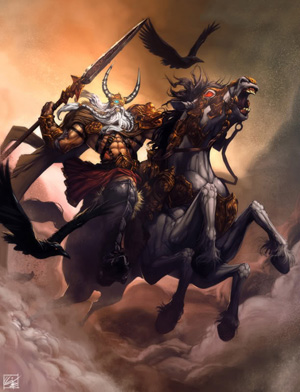
This one shows Odin's eight-legged steed (spider).

This shows Thor's size compared to the giant Hrungnir. It also shows the clay human the giants created from the heart of a mare.
I'd also like to revisit the poetry section and share a haiku:
His name is Yoda.
He comes when called; he knows
naught about Star Wars.
He comes when called; he knows
naught about Star Wars.
I'd also like to remind everyone of what primogeniture means: the first-born son inherits the family's wealth and possessions.
Monday, October 7, 2013
Some Original Poems
A Happy Poem (free-verse)
Sometimes, The Journey is not what it seems.
The path is clear but
beware the smoofas;
they hide under the bed.
The dial tone asks
too many questions.
Can I drink my way
to Heaven?
A man a plan a canal Panama.
A plan.
The shortest distance
between two points is a line.
How thick
should I draw the line?
What color
should it be?Should I
use a ruler?
What happens My favorite color
when a clock runs isgreen.
blue. red. green.
out of batteries?
No, this is
a happy poem. No more questions.
Time for answers.
My mother knows In music lies
the answers. the answer.
“Keep your head up.” Keep nodding your head.
“They’re jealous.” Never stop smiling.
“Be a leader.” Your insides define you.
We only have what we remember.
Surround yourself with love.
_________________________________________________________________________________
That Man Behind the Curtain (free-verse)
Pay no attention
to the words in this poem,
for you cannot even
call it one.
Attempting to find
symbols or hidden meanings will prove
to be a hindrance.
This poem is blunt and
straight-forward.
There shall be no debate
over its interpretation;
everything is right here,
flowing from my pen
to the page which started blank.
_________________________________________________________________________________
I liked my topic within "That Man Behind the Curtain" and wanted to go further and formalize it a bit. I wanted to turn it into a Shakespearean sonnet to both make fun of the sonnet tradition (troubadour love), and to create a love song to the sonnet and art itself. I hate to post a work-in-progress, but I'm stuck. I'm missing 2 lines from my final quatrain and also the closing couplet. Here is what I have; I would love criticism and feedback.
Sonnet I
Pay no attention to these words you read.
This po'm can hardly be defined as such.
If finding symbols is your desperate need,
I'm sorry that I have no artist's touch;
I bear no seer's sight nor bard's true tongue,
Inspired not by nature's 'ternal grace.
Alas, I cannot leave my song unsung.
Unclothe the body then expose her face.
Straightforward is this poem-- simple, too.
It means exactly what it says right here.....
Sometimes, The Journey is not what it seems.
The path is clear but
beware the smoofas;
they hide under the bed.
The dial tone asks
too many questions.
Can I drink my way
to Heaven?
A man a plan a canal Panama.
A plan.
The shortest distance
between two points is a line.
How thick
should I draw the line?
What color
should it be?
use a ruler?
What happens My favorite color
when a clock runs is
out of batteries?
No, this is
a happy poem. No more questions.
Time for answers.
My mother knows In music lies
the answers. the answer.
“Keep your head up.” Keep nodding your head.
“They’re jealous.” Never stop smiling.
“Be a leader.” Your insides define you.
We only have what we remember.
Surround yourself with love.
_________________________________________________________________________________
That Man Behind the Curtain (free-verse)
Pay no attention
to the words in this poem,
for you cannot even
call it one.
Attempting to find
symbols or hidden meanings will prove
to be a hindrance.
This poem is blunt and
straight-forward.
There shall be no debate
over its interpretation;
everything is right here,
flowing from my pen
to the page which started blank.
_________________________________________________________________________________
I liked my topic within "That Man Behind the Curtain" and wanted to go further and formalize it a bit. I wanted to turn it into a Shakespearean sonnet to both make fun of the sonnet tradition (troubadour love), and to create a love song to the sonnet and art itself. I hate to post a work-in-progress, but I'm stuck. I'm missing 2 lines from my final quatrain and also the closing couplet. Here is what I have; I would love criticism and feedback.
Sonnet I
Pay no attention to these words you read.
This po'm can hardly be defined as such.
If finding symbols is your desperate need,
I'm sorry that I have no artist's touch;
I bear no seer's sight nor bard's true tongue,
Inspired not by nature's 'ternal grace.
Alas, I cannot leave my song unsung.
Unclothe the body then expose her face.
Straightforward is this poem-- simple, too.
It means exactly what it says right here.....
Monday, September 30, 2013
Poetry and Weird Al
Alliteration, assonance, similes, and metaphors are no strangers to poetry and literature. Alliteration, the repetitive use of the same consonant sound, can be used to force words to sound sharp, pointed, or abrupt. Examples: cute kitten, slippery slide, plastic people, good God. Assonance, the repetitive use of the same vowel sound, can be used to sound airy, fluffy, light, or feminine. All rhymes are a type of assonance. Examples: shout loudly, fast pass, hot shot, home phone.
Metaphors and similes are used to compare two unlike things in hope of finding similarities. A simile is a comparison using "like" or "as" while a metaphor compares two things by calling one the other. Example: "Life is like a box of chocolates." On the surface, a box of chocolates and life don't seem to have much in common, but when Forest Gump explains, "You never know what you're gonna' get," the simile makes sense. Metaphor example: Life is a gray grain of sand on the world's most beautiful shore.
Weird Al has an incredible talent of rewriting songs to sound almost identical to their originals. This ability is difficult! Replacing words, phrases, and verses with similar ones that mock rhythm and syllables can be a daunting task. Weird Al, however, does such a good job that I do not know the real lyrics to "American Pie" anymore. Pathetically attempting to parody N*Sync's "Tearin' Up My Heart," I came up with the following:
"You're tearing up my couch
and my shoes.
Why can't you use the scratch post
I bought for you.
And no matter how many toys I leave around the house
You make me so mad at you."
Monday, September 23, 2013
Vaughan and Wordsworth on Innocence and Experience
Miles
Levy-Nordhoff
Wexler
Engl 495ESM
23 September
2013
Vaughan
and Wordsworth on Innocence and Experience
Because
so many authors have similar styles and discuss similar issues, it is easy to
come to a hasty conclusion that the authors were inspired by one another or
talking back to the other; however, it is an amazing phenomenon when two
authors are so similar that certain lines seem to be mimicking each other. Writing
150 years before William Wordsworth, the well-known ‘poet of nature’ who “defined”
poetry in his “Preface to the Lyrical Ballads,” the lesser-known Henry Vaughan
discussed similar themes of divinity, nature, innocence, and experience. Even
to an inexperienced litterateur, Wordworth’s “Ode” and Vaughan’s “The Retreat”
are undeniably similar in theme and style. It is known that Wordsworth had copies of
several of Vaughan’s works, proving Wordsworth was inspired by him. Although he
got many of his ideas from Vaughan, Wordsworth’s opinions of innocence and
experience differ slightly from Vaughan’s. While Wordsworth found value in
experience, Vaughan favors innocence in his poem, “The Retreat.”
Like Wordsworth, Vaughan values
innocence because it is divine and gives the ability to be closer to God.
Vaughan’s poem “The Retreat” begins, “Happy those early days! when I/ Shined in
my angel-infancy”(1-2). Vaughan compares the innocence of childhood to being an
angel in heaven. The poem’s narrator (assumed to be Vaughan, himself) explains
that his life on Earth is not his main purpose, “Before I understood this place/
Appointed for my second race,/ Or taught my soul to fancy ought/ But a white,
celestial thought” (3-6). Vaughan explains that an innocent (angelic) mind only
thinks about and desires God. Experience teaches one’s soul to desire ungodly
things. Wordsworth’s opening lines to his “Ode” seem to be a verbal echo of
these lines by Vaughan, “There was a time when meadow, grove, and stream,/ The
earth, and every common sight,/ To me did seem/ Apparelled in celestial light”
(1-4). Vaughan continues in his poem describing the loss of innocence like
walking away from God and looking back, seeing “a glimpse of his bright face”
(10). Both Wordsworth and Vaughan found tranquility and divinity in nature, but
in slightly different ways. Wordsworth, being a poet of nature, found true divinity and spirituality in nature.
Nature brought one back to times of divine innocence. In his critical essay “The
Source of Henry Vaughan’s Ideas Concerning God in Nature” A. C. Judson writes, “since
all nature possesses something of the Eternal spirit, the child, blessed with
the keenest memory of his celestial home, can most easily perceive it” (602). To
Vaughan, this is true, but it is only a shadow. “When on some gilded cloud or flower/ My gazing soul would dwell an hour,/ And in those weaker
glories spy/ Some shadows of eternity” (11-14). While Vaughan does find
divinity in nature, it is a “weaker glory.” Nature is just a mimetic
representation of the divine. Nature may seem eternal (it certain does to
Wordsworth), but, sounding like Plato, Vaughan believes anything physical is
temporary: mere “shadows of eternity.” He furthers this philosophy in the
lines, “But felt through all this fleshy dress/ Bright shoots of everlastingness” (19-20). Coleridge (a close confidant to
Wordsworth) seems to mimic these lines in his poem “Sonnet XVII”: “some have
said/ We lived ere yet this fleshy robe we wore” (5-6). These poets believe mortal
life is merely temporary and our skin and bodies are only for show.
While both Wordsworth and Vaughan
value innocence, Vaughan separates from Wordsworth’s ideology and views
experience as highly negative. If innocence is divinity and the ability to be
closer to God, then the opposite of that would be, trivially, ungodliness and
sinfulness. Vaughan describes innocence as the time “Before I taught my tongue
to wound/ My conscience with a sinful sound” (15-16). In these lines, Vaughan
is talking or arguing with his conscience (something supposed to determine
right from wrong), an effect of experience. The word choice of “taught” implies
willingness and even a choice to sin, thus proving experience is not to be
sought. Vaughan believes that the end goal, after this temporary, mortal “fleshy
dress,” is to return to innocence, in heaven with God: “Some men a forward
motion love,/ But I by backward steps would move” (29-30). The forward motion
he describes is a movement toward experience; backward steps is the movement
back to innocence and divinity. Vaughan, continues “And when this dust falls to
the urn/ In that state I came, return” (31-32). Again hinting that his mortal
body is temporary, he explains that he wants to return to innocence, where he
came. This could also symbolize a physical return to dust, for before he was mortal,
what was he? In her critical essay “Vaughan and Wordsworth” Helen N. McMaster
compares and contrasts Vaughan and Wordsworth’s texts and writes, “In Wordsworth’s
“Ode” there is no such confidence in the idea of a return [to innocence]; life
to him was not a great circular journey from a home which will be safely
reattained [sic] through the mercy of Christ, but a progressive evolution from
one state to another during which the spirit is encouraged to believe in its
immortality by recollections of childhood when common sights were ‘apparelled
in celestial light’” (322). Although Wordsworth was highly influenced by
Vaughan’s ideas and beliefs, their opinions on innocence and experience
differed. The differences between the two poets are at the same points where
likenesses can be found.
Works Cited
Coleridge, Samuel Taylor. "Sonnet XVII. Composed on a Journey
Homeward; The Author
Having Received Intelligence of the Birth of a
Son."Poem Hunter. Poem Hunter, n.d.
Web. 20 Sept. 2013.
Judson, A. C. "The Source of Henry Vaughan's Ideas Concerning
God in Nature." Studies in
Philology 24.4 (1927): 592-606. JSTOR.
Web. 20 Sept. 2013.
<http://www.jstor.org/stable/4171987>.
McMaster, Helen N. "Vaughan and Wordsworth." Review
of English Studies 11.43 (1935): 313-
25. JSTOR. Web. 20 Sept. 2013.
<http://www.jstor.org/stable/508084>.
Vaughan, Henry. "The Retreat." 100 Best-Loved
Poems. By Philip Smith. New York: Dover
Publications, 1995. 18-19. Print.
Wordsworth, William. "Ode Intimations of Immortality from
Recollections of Early
Childhood." The Oxford Book of
English Verse. Bartleby, n.d. Web. 20 Sept. 2013.
Monday, September 16, 2013
"Believe" by The Bravery
"We do our time like pennies in a jar/ What are we saving for?" Although ending with a preposition (blasphemy!), these lines promote questions about money, jobs, the system. We are each insignificant pennies in a jar, but what is the end result/reward? "We sit and grow our roots into the floor/ But what are we waiting for?" We get so comfortable and become selfish, thinking our own lives are of utmost importance. I hate to be depressing and blunt, but everyone dies; in fact, there are more dead people than people living.
My interpretation of this song is not totally depressing, though. The chorus, although sounding existential again, inspires hope: "So give me something to believe/ Cause I am living just to breathe/ And I need something more/ To keep on breathing for/ So give me something to believe." A quote I read the other day explains this chorus very well: "The most important skill of a species intelligent enough to understand both their insignificance and their mortality is the capability for distraction. Because the facts of reality are just too intense"(waitbutwhy.com). How do we deal with the fact that we know we are mortal? We are the only creatures that are conscious of the fact. We need something to believe!
Sources:http://www.waitbutwhy.com/2013/08/putting-time-in-perspective.html
http://www.azlyrics.com/lyrics/bravery/believe.html
Sources:http://www.waitbutwhy.com/2013/08/putting-time-in-perspective.html
http://www.azlyrics.com/lyrics/bravery/believe.html
Subscribe to:
Posts (Atom)